Seeing and Treating in One Step: Smart Nanoparticles Against Glioblastoma
As a researcher in the NanoBio4Can Project, my research focuses on developing targeted treatments for glioblastoma (GBM). It is one of the most aggressive forms of brain cancer. Treating GBM is a challenge because the brain is protected by the blood-brain barrier (BBB), which is a highly selective biological filter. While the BBB is essential for protecting the brain from harmful toxins, it also prevents nearly all cancer drugs from reaching the tumor site. To overcome this major obstacle, our project aims to design a smart, multifunctional nanoparticle system capable of crossing the barrier and attacking the tumor directly. To achieve this, we are developing a "theranostic nanoprobe"—a single platform that combines high-resolution diagnostic imaging with localized therapy. Our nanoprobe is an upconversion nanoparticle wrapped in a protective, carbon shell. This probe can be loaded with specialized light-sensitive therapeutic drugs designed to destroy cancer cells.
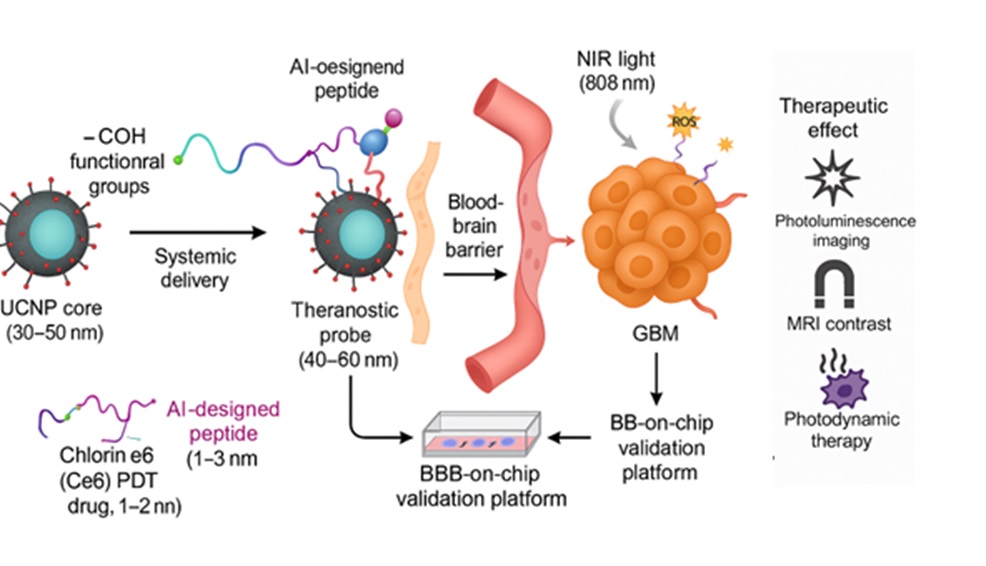
A powerful drug delivery system (DDS) needs precise navigation, which is why we use artificial intelligence (AI) to design custom peptides. When attached to the surface of nanoprobes, these AI-designed peptides allow the particles to bypass the blood-brain barrier and target GBM tumor cells specifically. To test this journey safely and accurately without relying on animal testing, we validate the platform using advanced microfluidic "BBB-on-a-chip" models. These cutting-edge lab chips realistically replicate human blood flow and tumor vessel interactions, giving us a highly accurate picture of how the probe performs in a human-like environment. Once the nanoprobes accumulate inside the tumor, applying harmless near-infrared light triggers a powerful two-in-one reaction: it lights up the tumor for fluorescence imaging while activating the drug to destroy the cancer cells from within. This dual-modality approach could pave the way for earlier brain tumor detection and more precise localized therapy. Working collaboratively within the MSCA COFUND NanoBio4Can project network provides an inspiring framework to translate these microscopic innovations into future clinical solutions for patients facing complex brain diseases. By sharing both our challenges and triumphs along the way, I hope to contribute to a future where smart nanotechnology makes brain tumors easier to see and safer to treat
Author: Syed Mujtaba ul Hassan, PhD
NanoBio4Can MSCA Co-Fund Fellow
Sabancı University Nanotechnology Research and Application Center (SUNUM)