Lung Cancer Sensor – Early Detection and Timely Treatment Can Significantly Reduce the Mortality Rates
According to the World Health Organization report, cancer remains the leading cause of deaths globally. Approximately 10 million people died due to cancer in 2020 which is equivalent to 1 in six deaths globally. Additionally, among all the cancer types, lung cancer was identified as the leading cause of cancer related deaths, responsible for an estimated of 1.8 million deaths (18.7%), followed by colorectal (9.3%), liver (7.8%), breast (6.9%) and stomach (6.8%). Major cause of the deaths associated with lung cancer is its diagnosis at advanced stages when symptoms become apparent, which reduces the effectiveness of treatment and increases the risk of mortality. Early detection and timely treatment can significantly reduce the mortality rates.
Lung cancer diagnosis/screening can be done by low-dose computed tomography, imaging (CT-Scan, MRI, X-ray), and biopsy etc. These methods are good but expensive for mass screening. Currently, no commercially available non-invasive lung cancer biomarker detection sensor does exist which can be used in clinical settings.
In this project, we will develop an electrochemical sensor for detecting lung cancer at an early stage, as shown in the following figure. Machine learning approach will be employed to optimize and select the most effective sensor coatings for accurate detection of the lung cancer at an early stage.
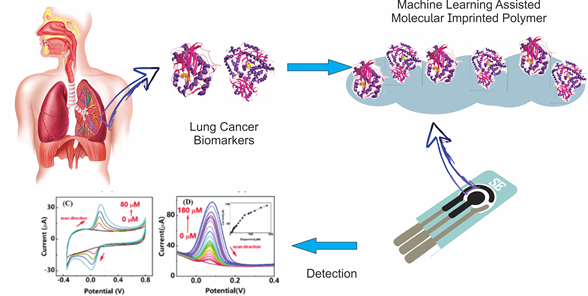
The proposed sensor platform not only promises improved diagnostic precision but also provides a framework for real-time, non-invasive lung cancer screening. The incorporation of machine learning into sensor design introduces a novel computational-experimental approach, paving the way for smarter and more efficient sensor development. Moreover, this project will contribute to the scientific community by expanding the knowledge base in synthetic recognition materials, multi-analyte detection strategies, and AI-assisted biosensor optimization. This project represents a novel approach in the field of lung cancer diagnostics by integrating AI driven molecular imprinting materials and electrochemical devices. Unlike traditional biopsy-based methods, this innovation offers a non-invasive, cost-effective, and highly sensitive alternative.
Author: Usman Latif, PhD
Author: Usman Latif, PhD
NanoBio4Can MSCA Co-Fund Fellow
Sabancı University Nanotechnology Research and Application Center (SUNUM)